
Last Call for Concrete and Deck Work Before Winter
There is no single cutoff for outdoor work in Pittsburgh, there are three. Stamped concrete has the earliest deadline and it is the seal thirty days after the pour, not the pour itself. Pavers depend on ground that will take compaction. Decks run latest and composite runs latest of all. What we will still build in October, and what we will tell you to put off until spring.
Quick Take: There is no single cutoff date for outdoor work in Pittsburgh. There are three, because concrete, pavers, and decks fail in different ways when the weather turns. Stamped concrete has the earliest deadline and it is not the pour date, it is the seal that comes about thirty days later. Pavers need a base compacted into ground that is neither frozen nor saturated. Decks run latest of the three and can be framed well into the cold. Our outdoor jobs have run three to five weeks on site, so late September is roughly when the concrete window closes for the year and the deck window starts getting tight.
Every September the calls change. All summer it is people planning; from about now it is people who have realized the season is finishing and want to know whether they have missed it. The honest answer depends entirely on what they are asking us to build, and most of them are surprised by which one has the earliest deadline.
Three products, three different deadlines
Homeowners tend to think of outdoor work as one category that shuts down when it gets cold. It is really three, and they behave differently.
Concrete is a chemical reaction that needs warmth to happen properly, and it needs a second warm dry window later for sealing. Pavers are a compaction problem, and compaction depends on the condition of the ground underneath. A deck is carpentry on top of footings, and carpentry does not much care about the temperature once the footings are in. That ordering is the whole article, and it runs opposite to what most people assume, because concrete feels like the tough permanent one.
Concrete: the deadline is the seal, not the pour
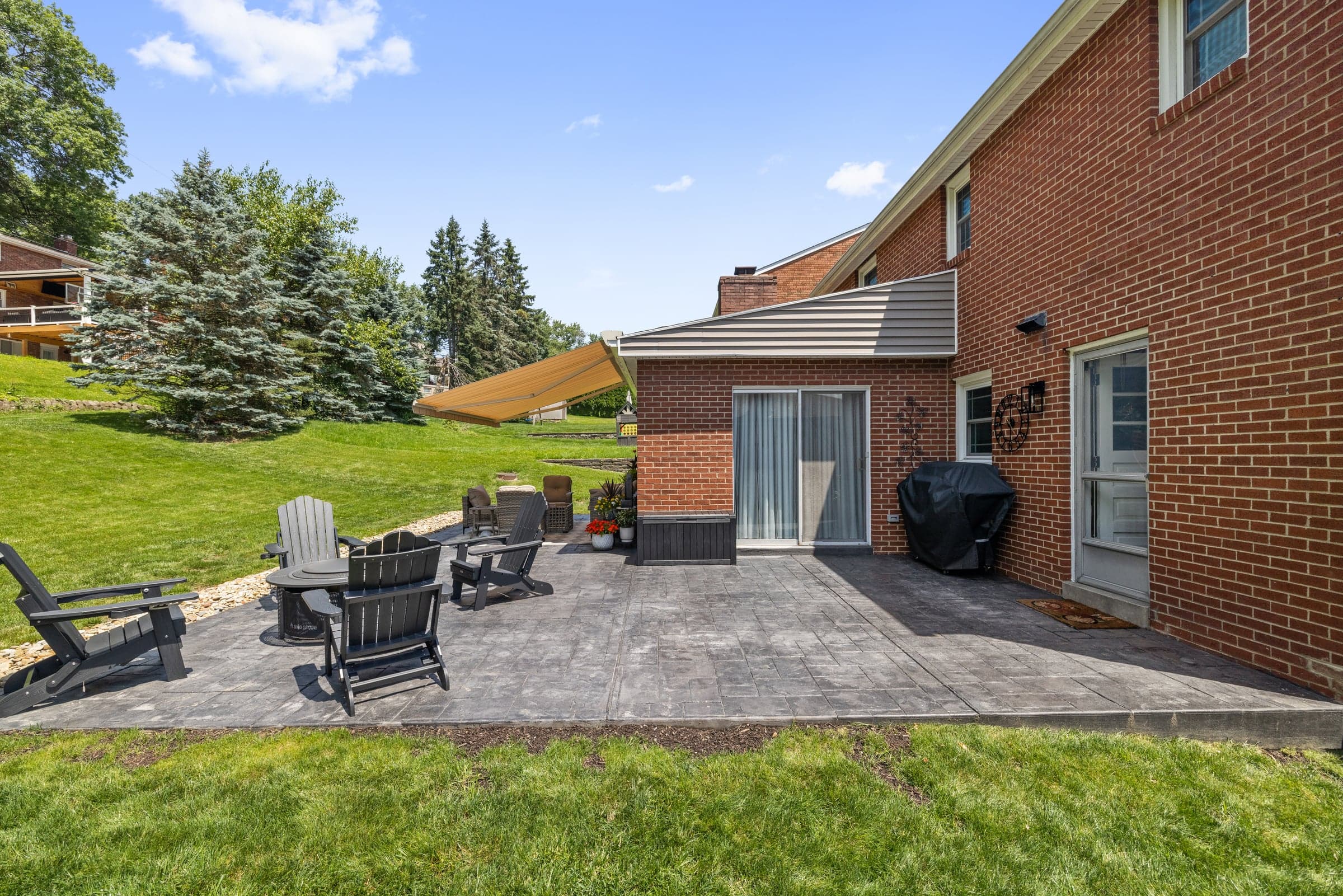
Our Hayson Avenue patio in Banksville is the clearest example of why the pour date misleads people. That job was 640 square feet of stamped concrete, five weeks on site. Sub-base prepared with six inches of compacted 2A modified stone, reinforcement laid before the pour, pattern stamped while the concrete was still workable, control joints saw-cut at engineered intervals so it cracks where we chose rather than where it wants to.
Then it was sealed twice. Once at install, and again after thirty days of cure.
That second seal is the deadline nobody puts on a calendar. It is not optional on stamped work, because the sealer is what protects the color and the surface through freeze-thaw, and it needs a dry slab and moderate temperatures to go down properly. Pour in late October and you are trying to seal at the end of November, when you may simply not get a suitable day. Then the patio goes into its first winter without the coat that was supposed to protect it, which is the winter it is most vulnerable.
Concrete also wants consistent temperatures while it cures rather than a hard freeze in the first days. There are cold-weather methods for pouring, and they are real, but they add cost and they do not solve the sealing problem at all. So for stamped work specifically, we treat the end of September as the honest edge of the season. After that we would rather book you for spring than take the deposit and hope for a mild November.
Pavers: you cannot compact ground that is frozen or soaked
Pavers are more forgiving than stamped concrete but they have their own limit, and it is underneath rather than on top. Our Legacy Drive patio in Canonsburg is 540 square feet, three weeks, excavated down to undisturbed subsoil with six inches of compacted base, a one inch bedding layer, polymeric sand in the joints and drainage tile tied into the existing downspout run. The Upper St. Clair patio was built the same way, with perimeter drainage graded to daylight.
All of that depends on compacting a base into ground that will actually take compaction. Saturated ground in a wet November does not compact, it pumps. Frozen ground does not compact either, and worse, it can look solid while you work and then settle when it thaws in March. A patio that moves in its first spring was almost always built on a base that was never properly compacted, and the homeowner has no way to see that at the time.
Polymeric sand has its own requirement: it is activated with water and then needs to dry. Doing that in cold damp weather is asking for a joint that never sets up correctly.
Pavers can run a few weeks later than stamped concrete, into October in a normal year. They cannot run into a wet freeze.
Decks run latest
Decks are the answer for anyone calling late, and it is worth knowing that before you give up on the year entirely.
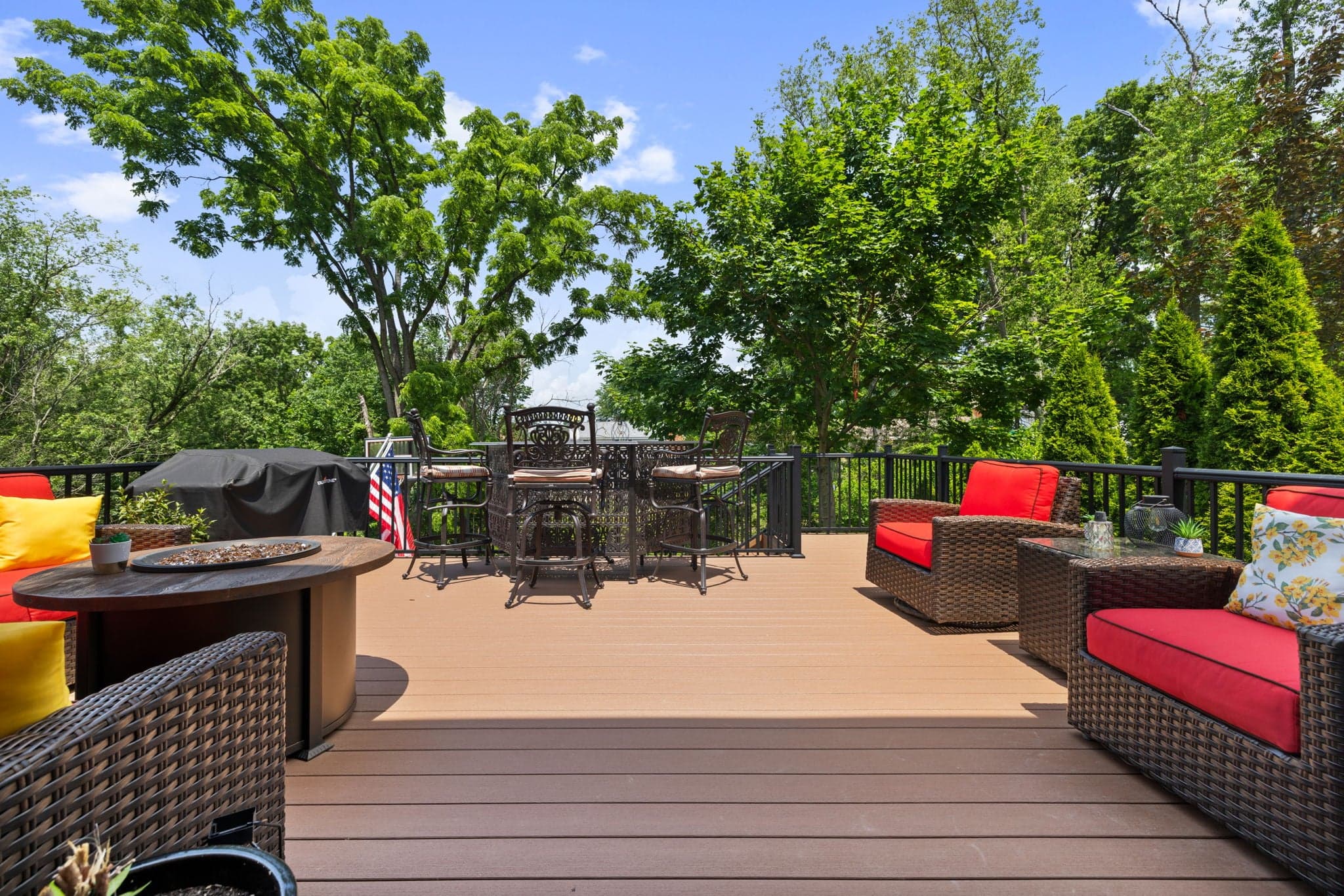
The weather-sensitive part of a deck is the footings, and once those are in the rest is carpentry. Our Worcester Drive deck in Mt. Lebanon went in over three weeks on new concrete footers set below the frost line, with double 2x10 rim joists, joists at twelve inches on center for the composite surface, and a lag-bolted ledger with continuous flashing. Old Boston Road in Whitehall ran five weeks on engineered footers, also below frost line, paired with a sliding door swap that needed the rough opening reframed.
Footings have to go below the frost line, and how deep that is gets set by your municipality, which is one of many things that varies across the county. We covered that variation in the permits by municipality post. Digging those footings is the part that gets harder as the ground hardens, and on Echo Glen in Whitehall the footers had to be stepped into bedrock on the lower tier, which is slow work in any weather.
Once the footings are in and inspected, framing and composite decking go down in cold perfectly well. What genuinely does not work late is staining or sealing a wood deck, because finishes need temperature and dry time. If you want a stained wood deck rather than composite, you are back to a concrete-like deadline. Composite sidesteps that entirely, which is part of why Worcester Drive went composite for a thirty year service life with no annual staining.
Work backward from the build, not forward from today
The mistake in September is thinking about the start date. What matters is the finish date, and our outdoor projects have run three to five weeks on site: Worcester Drive three, Windvale Drive three for a deck and pergola together, Airport Road four for a second-story rebuild on a 1920s house, Echo Glen five, Old Boston Road five, Hayson Avenue five.
Add design and selections before that, and a permit and inspection window that depends on your municipality. So a stamped patio you want finished and sealed this year needed to start some weeks ago. A deck you want usable by Thanksgiving is still realistic if the footings go in soon.
There is also a quieter reason to call in the fall even if the work happens in spring. Booking now means you are choosing a spring start date rather than joining a queue in March when everyone else has had the same idea over the winter.
When we tell you to wait
This is the part that costs us work, so it is worth stating plainly. If you call in November about a stamped concrete patio, we will tell you to wait for spring. We could pour it. We could take the deposit, use cold-weather methods, and hand you a slab in December that we cannot properly seal until April, having sat through its hardest winter unprotected. It would look fine on the day. It would not be the patio you paid for.
The same goes for a paver base on soaked ground, and for staining a wood deck in the cold. In each case the failure shows up months later, well after the invoice is settled, and it is impossible for a homeowner to attribute it to the decision that caused it. That is exactly why it is an easy corner to cut.
A deck in October, though, we will happily build. The deck versus patio post walks through which of the two suits your yard in the first place, and on Hayson Avenue the family came to us wanting a deck and left with a stamped patio after we mapped out the tradeoffs on the first walkthrough. Sometimes the seasonal answer changes the product, and that is a legitimate reason to have the conversation now rather than in March.
Common questions
When is it too late to pour a concrete patio in Pittsburgh?
For stamped concrete we treat the end of September as the honest edge. The limit is not the pour, it is the second seal that goes down about thirty days after, which needs a dry slab and moderate temperatures. Pour in late October and that seal lands at the end of November, when you may not get a suitable day, and the patio faces its first winter unprotected.
Can you build a deck in the winter?
Largely yes. The weather-sensitive part is digging and pouring footings below the frost line, which gets harder as the ground hardens. Once footings are in and inspected, framing and composite decking go down in cold weather without a problem. What does not work is staining or sealing a wood deck, which needs temperature and dry time.
Why can't pavers be laid in late fall?
Because the base has to be compacted into ground that will take compaction. Saturated ground pumps rather than compacts, and frozen ground can look solid while you work and then settle when it thaws in spring. Polymeric sand in the joints also needs to be watered in and then dry out, which cold damp weather prevents.
Is it cheaper to book outdoor work in the off season?
We do not discount for the calendar. The advantage of booking in fall for spring work is scheduling rather than price: you pick a start date instead of joining the queue that forms every March.
How long does a deck or patio take to build?
Our completed outdoor projects have run three to five weeks on site. Worcester Drive was three weeks, Windvale Drive three for a deck and pergola together, Airport Road four, and Echo Glen, Old Boston Road, and Hayson Avenue five each. Design, selections, and the permit window come before that.
What happens if concrete is poured too late in the year?
Two separate risks. Curing in a hard freeze early on can compromise the strength of the slab, which is why cold-weather pouring methods exist and add cost. The more common problem is the sealer, which may not get a suitable window before winter, leaving a stamped surface exposed through the freeze-thaw cycles it was supposed to be protected from.
Where this leaves you
If you want stamped concrete finished this year, that window is closing now and we would rather tell you than take the booking. Pavers have a little longer. A deck is still very much on the table, and if it is composite it can be built later than most people assume. If you are not sure which your yard actually wants, the deck versus patio guide is the place to start, and you can see how we build both on the exterior and outdoor page. Call us in the next few weeks and we will tell you honestly whether it is a this-year job or a spring one.
Our exterior & outdoor renovation page →
Driveways, decks, patios, retaining walls, outdoor kitchens — exterior work built for Pittsburgh weather.

Jordan Kelly is a co-owner and co-founder of Integrated Contracting & Renovations. A Pittsburgh native with an accounting degree from Saint Francis University, he has spent more than 15 years in Pittsburgh real estate and focuses on the numbers behind a renovation — what projects cost, what they return, and how homeowners finance them.
See how we built it.
Related reading.
Finishing a Basement in an Old Pittsburgh House
Both basements we have published are in newer houses, and that is exactly the comparison worth making. What a stone foundation, a low duct run, and eighty years of retrofitted mechanicals do to a basement project, the two free checks that tell you whether yours is a candidate at all, and why a partial finish is often the smarter plan rather than a compromise.
"General Contractors Near Me": How to Actually Vet the Ones You Find
Searching "general contractors near me" gives you a map full of pins and no way to tell them apart. Here's what "near me" should really mean in the Pittsburgh area, the questions that separate a real contractor from a good salesperson, and the red flags worth walking away from.
Hiring a Kitchen Contractor in Pittsburgh: What Actually Matters
The kitchen is the most trade-dense room in the house, which makes it the hardest room to hire for. What separates a real kitchen contractor from a cabinet installer, why opening a wall in an older Pittsburgh home is a structural question, what the work actually costs here, and how to vet the people you find.