
Kitchen Design Trends for 2026: What's In, What's Out, and What Lasts
What we're actually installing in Pittsburgh kitchens this year — the warmer palettes and honest materials that are in, the tired looks that are on the way out, and the difference between a trend worth chasing and one that'll date your kitchen in five years. Plus how to budget it with real recapture math.
Quick Take: The 2026 kitchen is warmer, quieter, and built from more honest materials than the all-white, all-gray kitchens of the last decade. What's genuinely in: warm woods and muted greens, two-tone cabinetry, quartz that reads like stone, slab or large-format backsplashes, panel-ready appliances, and bigger working islands. What's out: cold gray-on-gray everything, busy mosaic backsplashes, and open shelving pretending to be storage. But a trend is not a strategy. The kitchen is the highest-recapture room in the house — roughly 70% of its cost comes back as home equity in this market — so the smart move is to spend the trendy budget on paint and hardware and the permanent budget on layout, cabinets, and counters. Play with our investment calculator to see where the money goes before you fall for a Pinterest board.
Every kitchen project starts at a table with a stack of saved photos, and almost every stack has the same tension in it: half the images are this year's trend, half are the kitchen the homeowner will still love in 2036. Our job at that table is to tell the two apart honestly — because we're the ones who'll be back in a decade if we get it wrong. Here's how we're reading 2026 from the build side, not the magazine side.
What's genuinely in for 2026
These are the requests we're actually fielding and the finishes we're actually ordering right now, across kitchens from a Mt. Lebanon colonial to a Bethel Park split-level.
- Warmer palettes. The decade-long reign of stark white is easing. We're installing more warm woods — white oak, walnut tones — and muted, grounded greens and warm off-whites. Not loud color; warmth. A kitchen that feels like a room instead of an appliance.
- Two-tone cabinetry. A different color or wood on the island than the perimeter is the single most common upgrade in our 2026 design conversations. It breaks up a big cabinet run and lets a homeowner get a little bolder on the island — where a color change is cheaper to live with — while keeping the walls calm.
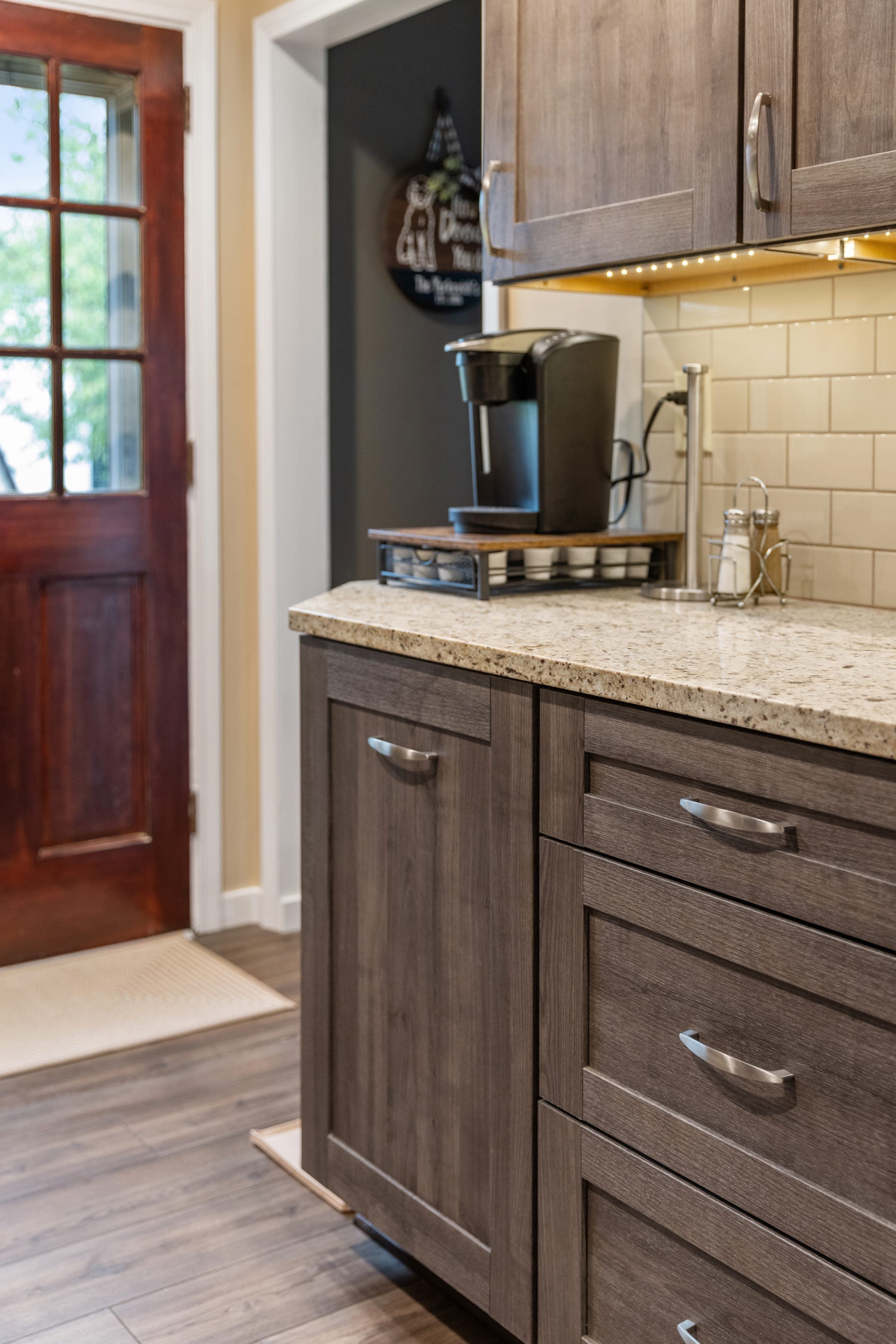
- Quartz that reads like natural stone. Quartz has quietly won the countertop argument, and the veining has gotten good enough that it convincingly stands in for marble without marble's staining and etching problems. On our Sherwood Drive kitchen in Whitehall, the homeowners asked for quartz by name and specifically not granite — that's the direction the whole market has moved.
- Slab and large-format backsplashes. Running the counter material up the wall, or using a large-format tile with minimal grout lines, instead of a busy small mosaic. Fewer grout lines to scrub, a cleaner look, and it photographs beautifully.
- Panel-ready and integrated appliances. Fridges and dishwashers that wear a cabinet front and disappear. In a higher-end build like our Nix Drive kitchen, hiding the appliances is what makes the cabinetry read as furniture rather than a showroom wall.
- A bigger island that actually works. Not bigger for its own sake — bigger because it's carrying seating, a prep sink, and real storage. The island is the piece of the kitchen people use hardest, and 2026 designs give it room to do its job.
- Warm metals, used with restraint. Brass and champagne-bronze fixtures are still in, but the tasteful version now is one warm accent — the faucet, or the pulls — not brass on every surface. Mixing one warm metal with a matte-black or chrome secondary looks intentional; matching everything looks like a catalog.
What's on the way out
Trends die quietly, but a few looks that defined the 2010s now read as dated the moment you walk in. We'll say so plainly, because steering you away from these is worth more than any finish we could sell you.
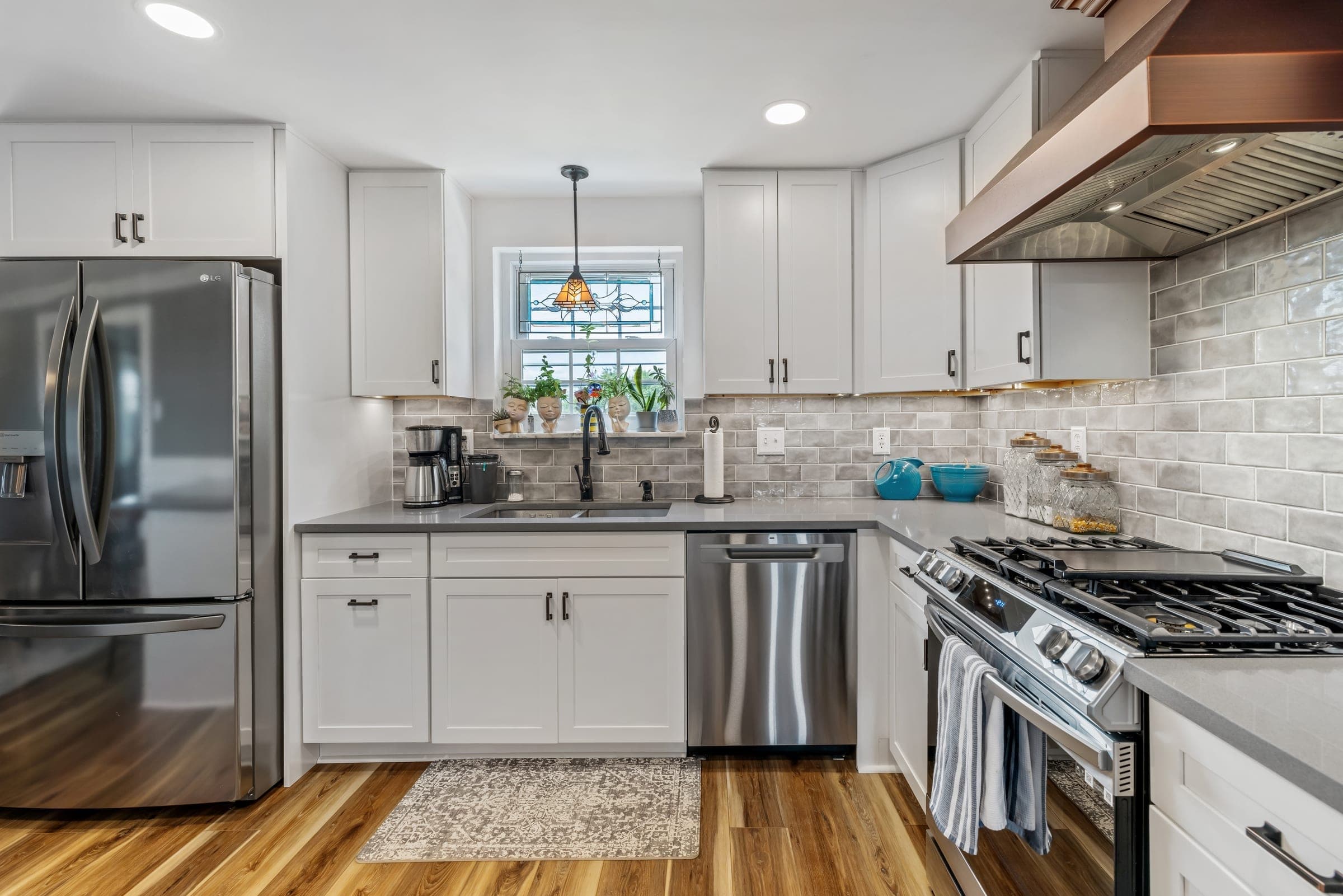
- Gray-on-gray everything. Cool gray cabinets, gray floors, gray counters, gray walls. It was the safe choice for years and it now reads as flat and cold. A soft grey still works beautifully as one voice in the room — our Sherwood Drive kitchen pairs soft-grey shaker with polished chrome and warm light and it holds up — but gray as the entire palette is finished.
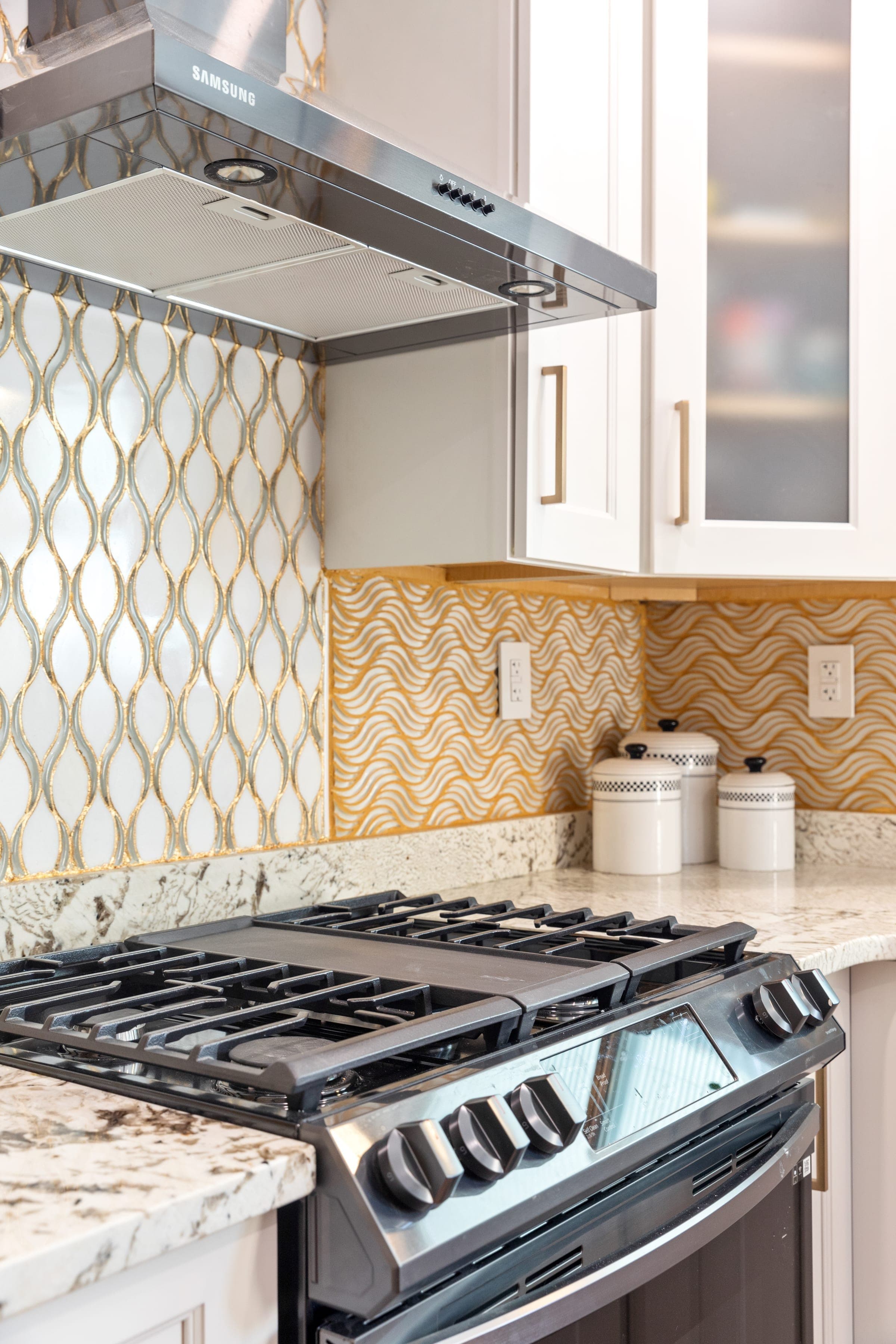
- Busy mosaic backsplashes. The intricate glass or penny-tile backsplash dates a kitchen faster than almost anything else, and it's a nightmare of grout lines to keep clean. This is a place we actively talk clients out of the trendy option.
- Open shelving as your main storage. Here's a genuine opinion: open shelving looks great in a photo and is a poor way to store the stuff a working kitchen actually holds. A shelf or two as an accent is fine. Replacing your upper cabinets with it means dusting dishes you don't use and staring at the ones you do. Most families who install it ask for cabinets back.
- All-white, no warmth. The all-white kitchen isn't wrong, but the flat, cold version of it — white cabinets, white counter, white subway, no wood or warmth anywhere — is the look 2026 is moving away from. A little warmth, one wood element, and it's timeless again.
- Barn doors and other 2016 gestures. Some trends were always going to age. If you'd have to explain to a 2030 buyer why it's there, think twice.
The line between a trend and a decision you can't undo
Here's the framing we actually use with clients, and it's the most useful thing in this whole post. Split your kitchen into two budgets.
The trend budget is everything you can change in a weekend without a contractor: wall paint, cabinet hardware, light fixtures, bar stools, a runner. Chase whatever you love here. If the warm-brass-and-green look you're into in 2026 feels tired in 2031, you're out a few hundred dollars and a Saturday. Go bold.
The permanent budget is everything that takes demolition to undo: the layout, the cabinet boxes, the counters, the flooring, where the plumbing and the range live. This is where trends will bankrupt your patience. Spend this money on timeless, not trendy — good shaker or clean flat-panel doors, quartz in a quiet pattern, a layout that works. Our whole design philosophy on our Sherwood Drive project was exactly this: "the kind of kitchen that won't feel dated in ten years." That's not a marketing line, it's a budgeting rule. If you want the deeper cost breakdown by material and door style, our kitchen remodel cost guide and kitchen styles guide both go further than we can here.
Layout beats finish every time
The most durable "trend" isn't a color at all — it's the continued pull toward open, connected kitchens that work for how families actually cook and gather. But open-concept is a structural decision, not a finish decision. Taking down the wall between a kitchen and a dining room, like we did at Sherwood Drive, means a structural header, sometimes moving a load path, and always bringing old wiring up to code. It's the highest-impact change you can make and the one you can't reverse with paint. We wrote a whole honest breakdown of what that costs in our open-concept kitchen cost post — worth reading before you commit, because in an older Pittsburgh home the wall you want gone is frequently holding the second floor up.
What a 2026 kitchen costs — and what comes back
No invented numbers here, just what we build and what it returns. Our completed Pittsburgh kitchens run a wide range depending on scope: a cabinet-and-counter refresh sits in the low $30Ks (our Sherwood Drive kitchen landed at $30K–$35K), while a full gut with custom cabinetry, panel-ready appliances, and a moved wall runs into the $50K–$64K range (Nix Drive, and our Royce Avenue kitchen in Mt. Lebanon, both live up there). The investment calculator will put a real range on your scope in about a minute.
The reason the kitchen is worth doing well: it's the strongest-recapture room in the house. In the Pittsburgh market a kitchen returns on the order of 70% of its cost in added home equity — a $60,000 kitchen adds roughly $42,000 in value — and that value then appreciates with the house. The full ROI math is here. It's also the room a buyer walks into and decides on, which is why chasing a look that'll date badly is a real financial risk, not just a taste one.
A note on how you'd pay for it, because it's the question people are too polite to ask: we bill on four milestones — 15% to hold the schedule and start design, 35% on the first day of construction, 35% at the mid-project mark, and the last 15% only after you've walked the finished kitchen and approved it. Payments track work done. Any contractor asking for most of the money up front is solving their cash flow, not protecting your project.
Common questions
What kitchen colors are trending in 2026?
Warmer and more grounded than the last decade: warm woods like white oak and walnut tones, muted and warm-leaning greens, and warm off-whites, often in a two-tone combination with a bolder island against a calmer perimeter. The cool, all-gray palette that dominated the 2010s is the main thing on the way out. A single warm metal accent — brass or champagne bronze on the faucet or the pulls — is the current tasteful note, rather than warm metal everywhere.
Is white kitchen cabinetry out of style for 2026?
Not out, but the cold, all-white version is fading. A white or off-white kitchen with one warm element — a wood island, a wood floor, warm hardware — still reads as timeless. The look 2026 is moving away from is flat white-on-white-on-white with no warmth anywhere in the room. If you love white, keep it and add one wood or warm-metal voice.
Which kitchen trends should I avoid because they'll date quickly?
Busy mosaic backsplashes, gray-on-gray-on-gray palettes, open shelving used as your primary storage, and one-off gestures like barn doors are the ones we most often steer clients away from. The rule of thumb: anything that takes demolition to undo should be timeless, and anything you can change in a weekend (paint, hardware, fixtures) is where it's safe to chase a trend.
How much does a kitchen remodel cost in Pittsburgh in 2026?
It depends heavily on scope. Our completed kitchens run from the low $30Ks for a cabinet-and-counter refresh (Sherwood Drive landed at $30K–$35K) up to the $50K–$64K range for a full gut with custom cabinetry and a reconfigured layout (Nix Drive and Royce Avenue). The investment calculator will give you a realistic range for your specific project in about a minute, and a walk-through turns that range into a line-by-line number.
Is a kitchen remodel a good investment?
It's the best-recapturing renovation in the house. A Pittsburgh kitchen returns roughly 70% of its cost in added home equity — about $42,000 back on a $60,000 kitchen — and that equity then appreciates with the home. It's also the room buyers judge a house on first. That's exactly why chasing a look that dates badly is a financial risk, not only a matter of taste.
What's better for countertops in 2026, quartz or granite?
Quartz has become the default request, and for good reason: today's quartz veining convincingly reads like natural stone, it's non-porous so it won't stain or etch like marble, and it doesn't need periodic sealing like granite. Granite still has its fans, but the market — and most of our clients — have moved to quartz for the combination of a stone look and near-zero maintenance.
Where this leaves you
Trends are fun, and 2026's are genuinely nicer than the last cycle's — warmer, calmer, more honest materials. Just spend them in the right place. Put your adventurous budget on the things paint and a screwdriver can change, and put your permanent budget on a layout and a cabinet-and-counter package you'll still love when the trend has turned over twice. Start with the investment calculator to see what your kitchen would cost and return, browse the kitchens we've built, or book a walk-through and we'll help you sort the timeless from the temporary at that same table.
Our kitchens renovation page →
The kitchen is the heart of the home — designed, built, and finished around how you actually cook.

Jordan Kelly is a co-owner and co-founder of Integrated Contracting & Renovations. A Pittsburgh native with an accounting degree from Saint Francis University, he has spent more than 15 years in Pittsburgh real estate and focuses on the numbers behind a renovation — what projects cost, what they return, and how homeowners finance them.
See how we built it.
Related reading.
What a Bathroom Remodel Actually Costs in Pittsburgh
Eight completed Pittsburgh-area bathrooms with real numbers attached, from a $25,000 Brookline gut to a three-bathroom Whitehall job at $56,000 to $62,000. Why the smallest room on the list cost more than a bigger one, where the money actually goes once tile covers it, and how to read a finish materials allowance before you sign.
Bathroom Renovation in Mt. Lebanon: What a Full Gut Actually Adds
Mt. Lebanon's older homes hide their bathrooms' age well until you start the work. Here's what a full gut remodel involves in a 1920s four-square, why waterproofing done right is the part you're really paying for, what it returns in equity, and how to budget it before you call anyone.
Try Our Renovation Investment Calculator Before You Call a Contractor
The first question every homeowner has is "what will this cost?" — and most contractors won't answer it until they're standing in your kitchen. Our free investment calculator gives you an honest starting range in about thirty seconds, built from real ICR project data.