
Bathroom Renovation in Mt. Lebanon: What a Full Gut Actually Adds
Mt. Lebanon's older homes hide their bathrooms' age well until you start the work. Here's what a full gut remodel involves in a 1920s four-square, why waterproofing done right is the part you're really paying for, what it returns in equity, and how to budget it before you call anyone.
Quick Take: In Mt. Lebanon's older housing stock, a bathroom is rarely a cosmetic job once you open the walls — the plumbing, the subfloor, and the waterproofing behind the tile are usually the real story. A full gut remodel is the honest answer in most of these homes, and it's a genuine investment: a bathroom returns roughly 65% of its cost in added equity in this market, with outsized daily-life impact per dollar. The money you can't see — the waterproofing membrane, the re-run supply lines, the reinforced subfloor — is the part that determines whether the room lasts twenty years or leaks in five. Before you call anyone, run your scope through the investment calculator for a realistic range.
Most Mt. Lebanon bathrooms look fine right up until the demo. We've worked all over this town — the Royce Avenue kitchen, the Worcester Drive deck — and the pattern in the older homes is consistent: a bathroom that was updated once in the 1990s over bones that are original to a 1920s four-square. Pull the vanity and you find galvanized supply lines. Pull the tile and you find no waterproofing behind it, just mastic on drywall. That's not a reason to panic. It's the reason a real bathroom remodel here is a gut, not a face-lift.
Why cosmetic rarely works in these homes
A "cosmetic" bathroom update — new vanity, new fixtures, paint, maybe re-tiling over the old — is a fine idea in a house from 2005. In a Mt. Lebanon home from the 1920s it usually just buries problems you'll pay to uncover later. Here's what's typically hiding:
- Original or half-updated plumbing. Galvanized supply lines that have been narrowing with corrosion for decades, and cast-iron or old drainage that may or may not be pitched correctly. Tiling over that is spending good money to make it harder to reach later.
- No real waterproofing. The single most common thing we find behind old tile is that there never was a waterproofing system — just tile stuck to drywall or, worse, to old plaster. That's a slow leak waiting for a grout crack, and it's why so many older baths have soft spots or a stain on the ceiling below.
- A subfloor that's been quietly wet. Around toilets and tubs especially, decades of small leaks leave a subfloor that needs replacing or reinforcing — which you only see once the floor is up.
- Layouts built for 1925. A single cramped full bath, a step-over tub as the only option, a 24-inch door. These were fine for the era and don't fit how people live now.
A full gut lets us fix the room down to the studs and joists, put in a proper waterproofing system, and reset the layout — so what you see and what you don't are both new. That's the version that lasts.
The part you're really paying for is invisible
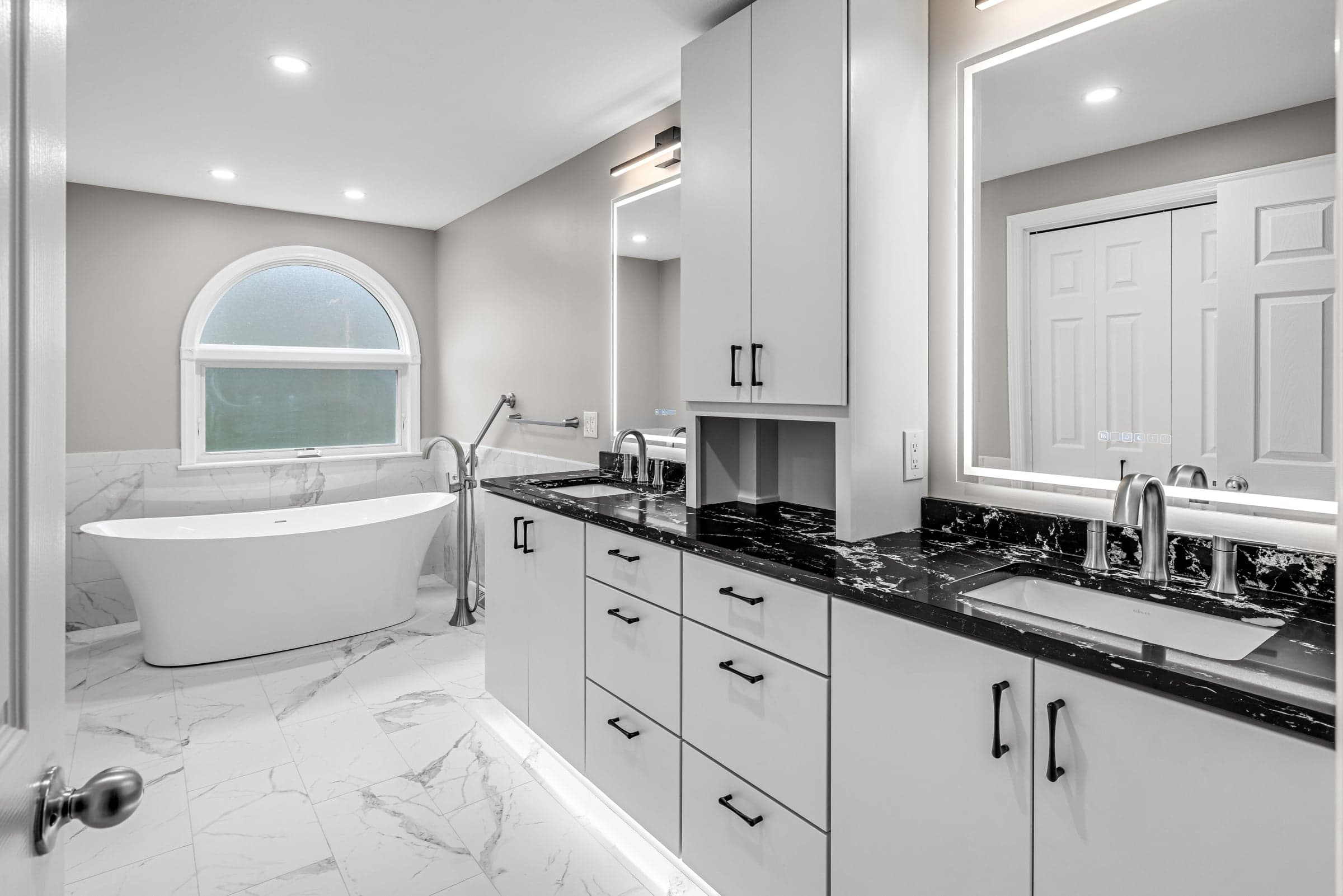
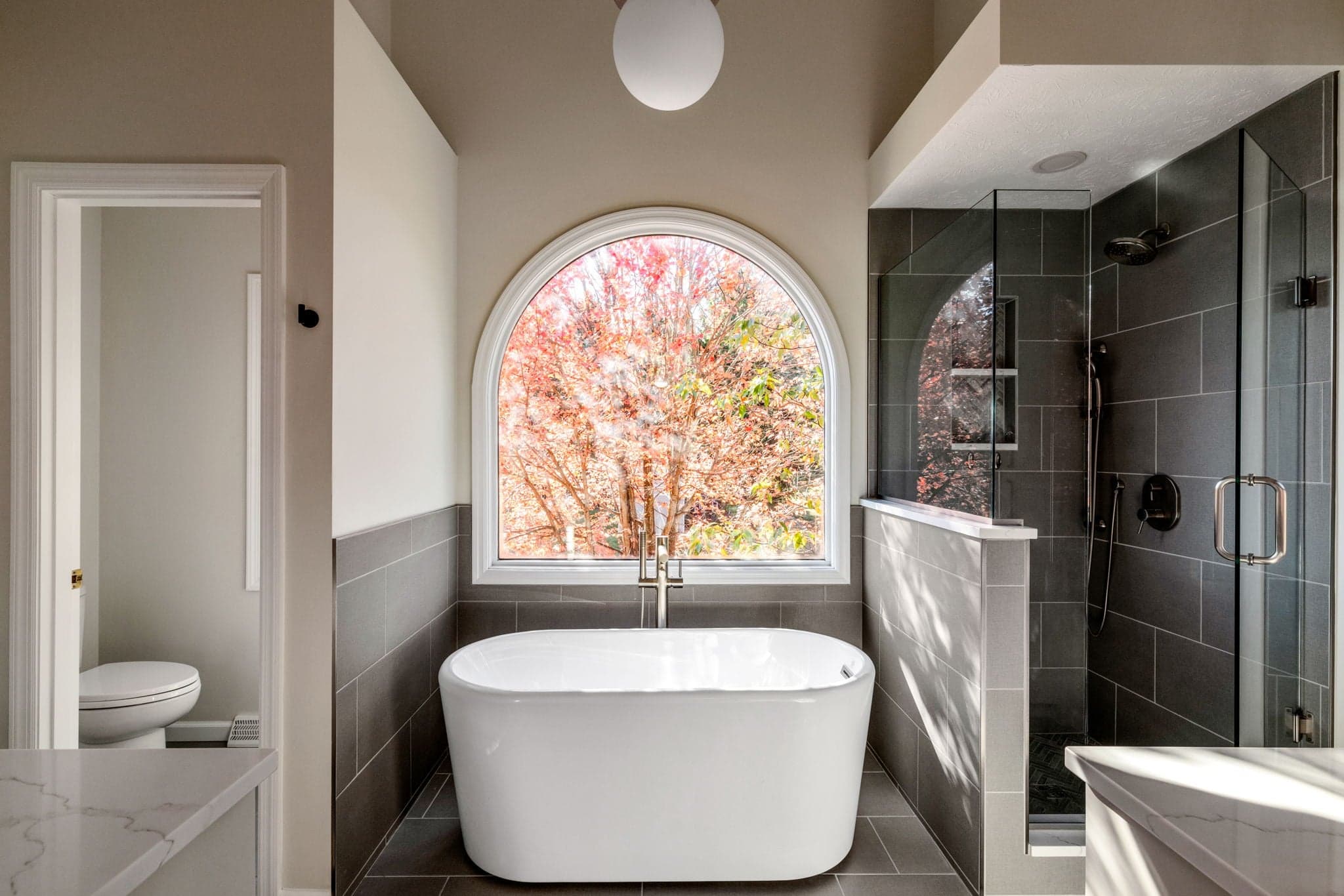
Here's the honest truth about bathroom value, and it's counterintuitive: the finishes you picked the room for matter less to its longevity than the work you'll never see. On our Majestic Drive primary bath in Peters Township — a full gut of a dated 1990s bath — the freestanding tub and matte-black fixtures are what the photos show, but the reason that room will still be sound in 2045 is underneath: every supply line re-run, the subfloor reinforced where the cast-iron tub sits, and a full vapor barrier and Schluter waterproofing system tested to a 48-hour flood standard before a single tile went in.
That is the part of a bathroom you're actually buying. A contractor who quotes a Mt. Lebanon bath meaningfully cheaper than the rest is almost always leaving the invisible work out — skipping the waterproofing membrane, tiling over questionable subfloor, leaving the old supply lines. It photographs identically on day one. It's a different room in year five. We wrote up the most common ways this goes wrong in our bathroom design mistakes post; the through-line is that the cuts you can't see are the expensive ones.
What actually adds value in a Mt. Lebanon bath
If the goal is equity and not just a nicer morning, a few moves carry more weight than the rest — and they're the same ones that make the room better to live in:
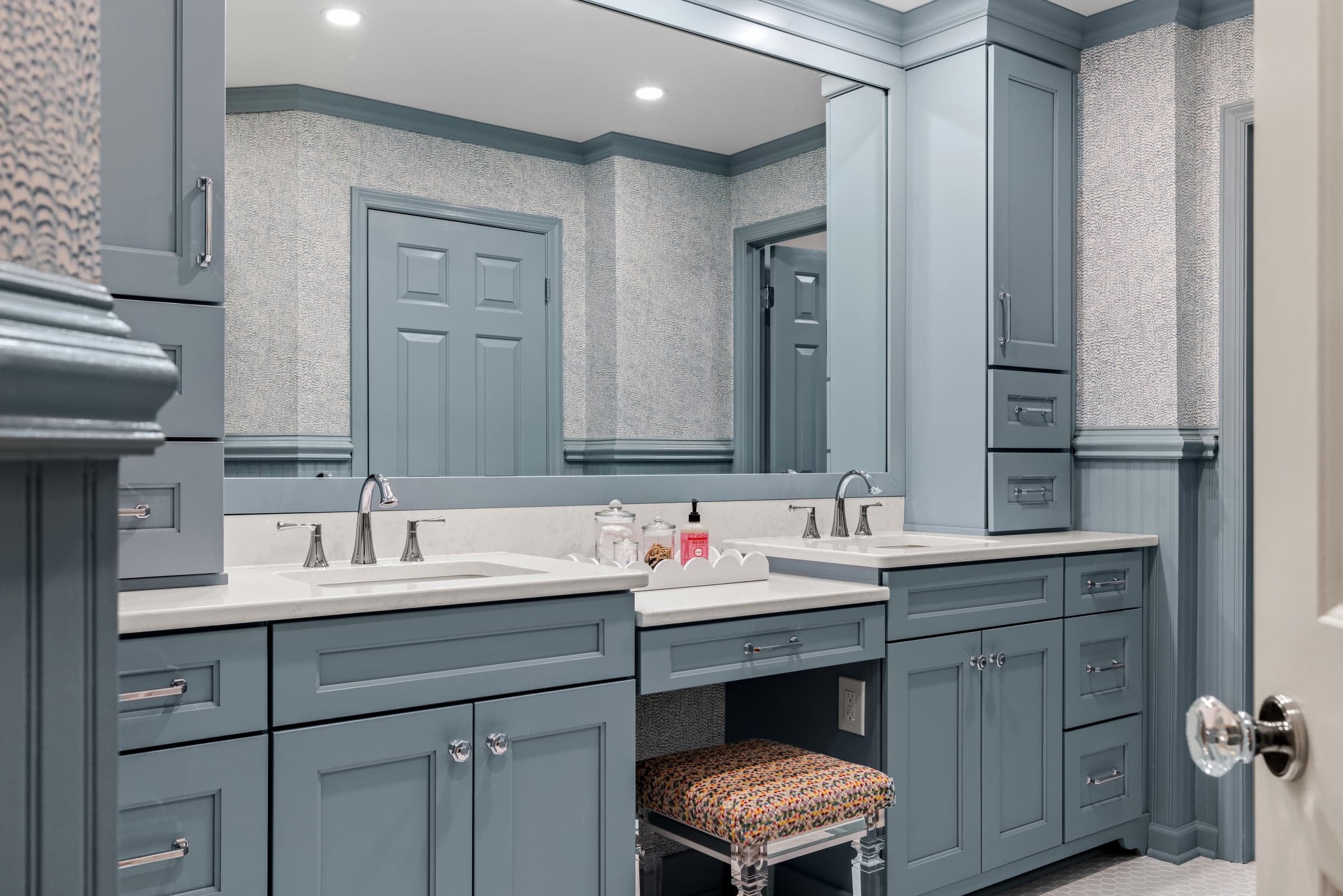
- A proper primary bath. The biggest value jump in these older homes comes from turning a cramped, single-sink bath into a real primary suite bath — a full standing shower, a double vanity where the layout allows, honest storage. Our Upper St. Clair primary baths on Heartwood Drive and Rossmoor Drive are both this move, and both landed in the $40K–$50K+ range for a reason: reconfiguring, not just refinishing.
- A curbless, high-end shower. A zero-threshold shower with a linear drain and frameless glass reads as premium to any buyer, and it happens to be the single most useful long-term feature you can build. We get into why in our aging-in-place post — it's a feature, not a compromise.
- Finishes that won't date. Porcelain tile across the room for seamless waterproofing, a quiet quartz vanity top, clean fixtures. Trendy tile in a bathroom dates the room fast and is expensive to redo. Timeless holds its value.
- Fixing the layout, not just the surfaces. Moving a wall, widening a door, borrowing a closet to make the room work — the structural changes are what separate a bathroom that feels new from one that just looks new.
The Mt. Lebanon permit reality
One thing specific to renovating here: Mt. Lebanon runs its own permitting, and it's more involved than some neighboring municipalities. A full bath gut that touches plumbing and electrical needs permits and inspections, and that's a good thing — it's the paperwork that proves the invisible work was done right. We handle it as part of the job, but if you want to understand how the town's process actually runs before you start, we wrote a dedicated Mt. Lebanon building permit guide. Any contractor suggesting you skip the permit to save time is offering to make your future home sale harder.
What it costs, and what comes back
No invented numbers — here's what our completed South Hills bathroom guts actually run. A straightforward full bath remodel starts around the mid-$20Ks (our Barbados Avenue bath in Brookline landed at $25K+). A full primary-suite bath with reconfiguration and premium finishes runs into the $40K–$50K+ range (Heartwood, Rossmoor, and the Majestic Drive bath all live there). A whole-house bathroom program — several baths at once — scales from there. The investment calculator will put a real range on your specific scope in about a minute, and the estimate tool is the faster four-question version.
On the return: a bathroom recaptures about 65% of its cost in added home equity in the Pittsburgh market, and that equity then appreciates with the house. Smaller check than a kitchen, but a reliable return and an outsized effect on daily life. The full ROI breakdown is here.
How you pay: four milestones — 15% to hold the schedule and start design, 35% on the first day of construction, 35% at the mid-project mark, and 15% only after you've walked the finished bath and signed off. Payments follow the work. Be wary of anyone who wants most of it before the crew shows up.
Common questions
Do I need a full gut, or can I just update the bathroom cosmetically?
In most of Mt. Lebanon's older homes, a full gut is the honest answer. Cosmetic updates leave the real issues — corroded galvanized supply lines, missing waterproofing behind the tile, and a subfloor that's often been quietly wet — buried under new finishes you'll eventually pay to remove. In a newer home a cosmetic refresh can make sense; in a 1920s four-square it usually just defers the real cost.
How much does a bathroom renovation cost in Mt. Lebanon?
It depends on scope. ICR's completed South Hills bathroom guts run from around $25K for a straightforward full remodel (Barbados Avenue) up into the $40K–$50K+ range for a primary-suite bath with reconfiguration and premium finishes (Heartwood Drive, Rossmoor Drive, Majestic Drive). The investment calculator gives a realistic range for your specific project, and a walk-through turns that into a line-by-line number against your actual house.
What's the most important part of a bathroom remodel?
The waterproofing you can't see. A proper vapor barrier and waterproofing membrane behind the tile and under the floor — tested before any finish work goes in — is what determines whether the room lasts twenty years or leaks in five. It's also the first thing a too-cheap quote leaves out, because it photographs identically on day one and fails quietly later.
Does a bathroom remodel add value to a home?
Yes — a bathroom returns roughly 65% of its cost in added home equity in the Pittsburgh market, and that equity appreciates with the house. It's a smaller absolute return than a kitchen but a reliable one, with a large impact on daily life per dollar spent. The biggest value jumps come from converting a cramped older bath into a real primary-suite bath rather than just refinishing what's there.
Do I need a permit for a bathroom renovation in Mt. Lebanon?
A full gut that touches plumbing and electrical does, and you want it. Mt. Lebanon runs its own permitting and inspections, and that paperwork is what documents that the plumbing and waterproofing were done to code — which protects you at resale. ICR handles permitting as part of the project. A contractor suggesting you skip it to save time is trading your future home sale for their schedule.
How long does a bathroom renovation take?
A full primary-bath gut typically runs about five weeks of on-site work once construction starts, plus design and ordering time up front. Older Mt. Lebanon homes occasionally add time when the demo reveals plumbing or subfloor conditions that need addressing — which is exactly why we build the scope around what's actually behind the walls rather than a fixed template.
Where this leaves you
A bathroom in an older Mt. Lebanon home is one of those projects where the cheapest quote and the right quote are rarely the same, because most of what you're paying for is behind the tile. Do it once, do it to the studs, and you get a room that returns real equity and lasts. Start with the investment calculator to see the range and the return for your bath, look through the bathrooms we've built, or book a walk-through and we'll tell you honestly what your house is hiding before you commit a dollar.
Our bathrooms renovation page →
Bathrooms may be one of the smaller spaces in a home — but they require some of the most detailed planning.

Jordan Kelly is a co-owner and co-founder of Integrated Contracting & Renovations. A Pittsburgh native with an accounting degree from Saint Francis University, he has spent more than 15 years in Pittsburgh real estate and focuses on the numbers behind a renovation — what projects cost, what they return, and how homeowners finance them.
See how we built it.
Related reading.
What a Bathroom Remodel Actually Costs in Pittsburgh
Eight completed Pittsburgh-area bathrooms with real numbers attached, from a $25,000 Brookline gut to a three-bathroom Whitehall job at $56,000 to $62,000. Why the smallest room on the list cost more than a bigger one, where the money actually goes once tile covers it, and how to read a finish materials allowance before you sign.
Kitchen Design Trends for 2026: What's In, What's Out, and What Lasts
What we're actually installing in Pittsburgh kitchens this year — the warmer palettes and honest materials that are in, the tired looks that are on the way out, and the difference between a trend worth chasing and one that'll date your kitchen in five years. Plus how to budget it with real recapture math.
Try Our Renovation Investment Calculator Before You Call a Contractor
The first question every homeowner has is "what will this cost?" — and most contractors won't answer it until they're standing in your kitchen. Our free investment calculator gives you an honest starting range in about thirty seconds, built from real ICR project data.