
Hiring a Kitchen Contractor in Pittsburgh: What Actually Matters
The kitchen is the most trade-dense room in the house, which makes it the hardest room to hire for. What separates a real kitchen contractor from a cabinet installer, why opening a wall in an older Pittsburgh home is a structural question, what the work actually costs here, and how to vet the people you find.
Quick Take: A kitchen pulls together more trades than any other room in a house — cabinetry, counters, plumbing, gas, electrical, structure, tile, sometimes HVAC — which is exactly why the contractor you pick matters more here than almost anywhere else. Plenty of outfits can hang cabinets. Far fewer can open a load-bearing wall, re-run a gas line to permit, and land a 200-amp panel upgrade in the same six weeks without the job falling apart. In the older Pittsburgh housing stock we work in, most real kitchen projects need that second kind. Below is how to tell them apart, what the work honestly costs here, and how to check the ones you find. If you want a realistic number for your own kitchen before you talk to anyone, our investment calculator gives you a range in about thirty seconds.
Search "kitchen contractors pittsburgh" and you get a wall of names that all promise the same thing. The photos look similar, the reviews average four-and-a-half stars, and none of it tells you the one thing that matters: which of these people can actually run the job your kitchen needs. Because a kitchen isn't one job. It's six or seven trades stacked into one room on a tight sequence, and the difference between a contractor and a cabinet installer only shows up when something behind the wall isn't what anyone expected.
Why the kitchen is the hardest room to hire for
A bathroom is plumbing and waterproofing. A basement is moisture and framing. A kitchen is all of it at once. Walk through what a real remodel touches: base and wall cabinets set dead level, stone counters templated and seamed, a sink drain and supply lines moved to a new location, a gas line for the range, dedicated circuits for the dishwasher and the microwave, often a panel that has to grow to carry the new load, tile from counter to ceiling, flooring that has to meet the dining room without a lip, and — the moment it becomes a real project — a wall coming out to open the space.
Each of those is a licensed trade or a skilled one, and they have to happen in the right order or they undo each other. Cabinets can't set until the floor's in and the walls are true. The plumber's rough-in has to be inspected before the tile closes the wall. Miss the sequence and you're paying someone to open finished work back up. A contractor who runs kitchens for a living is really selling you sequencing and coordination — keeping five trades from stepping on each other — far more than they're selling you cabinets. That's the part you can't see in a portfolio photo, and it's the part that goes wrong on jobs run by people who install kitchens between other work.
A "kitchen remodeler" and a contractor who can open a wall are not the same thing
Here's the line that matters most in this town, and almost nobody searching draws it. A lot of "kitchen remodelers" are cabinet-and-counter companies. They'll swap your layout for a nicer version of the same layout — new boxes where the old boxes were, new stone on top. If that's genuinely all you want, they're fine, and they're often cheaper because they never touch the structure.
But most people searching for a kitchen contractor in Pittsburgh don't actually want the same layout. They want the wall between the kitchen and the dining room gone. And in the housing stock here — the mid-century splits and ranches across the South Hills, the pre-war colonials up north — that wall is very often load-bearing. That's not a design change anymore. It's a structural one, and it needs an engineered header, a permit, temporary shoring while the wall comes down, and the header tied back into the load path correctly.
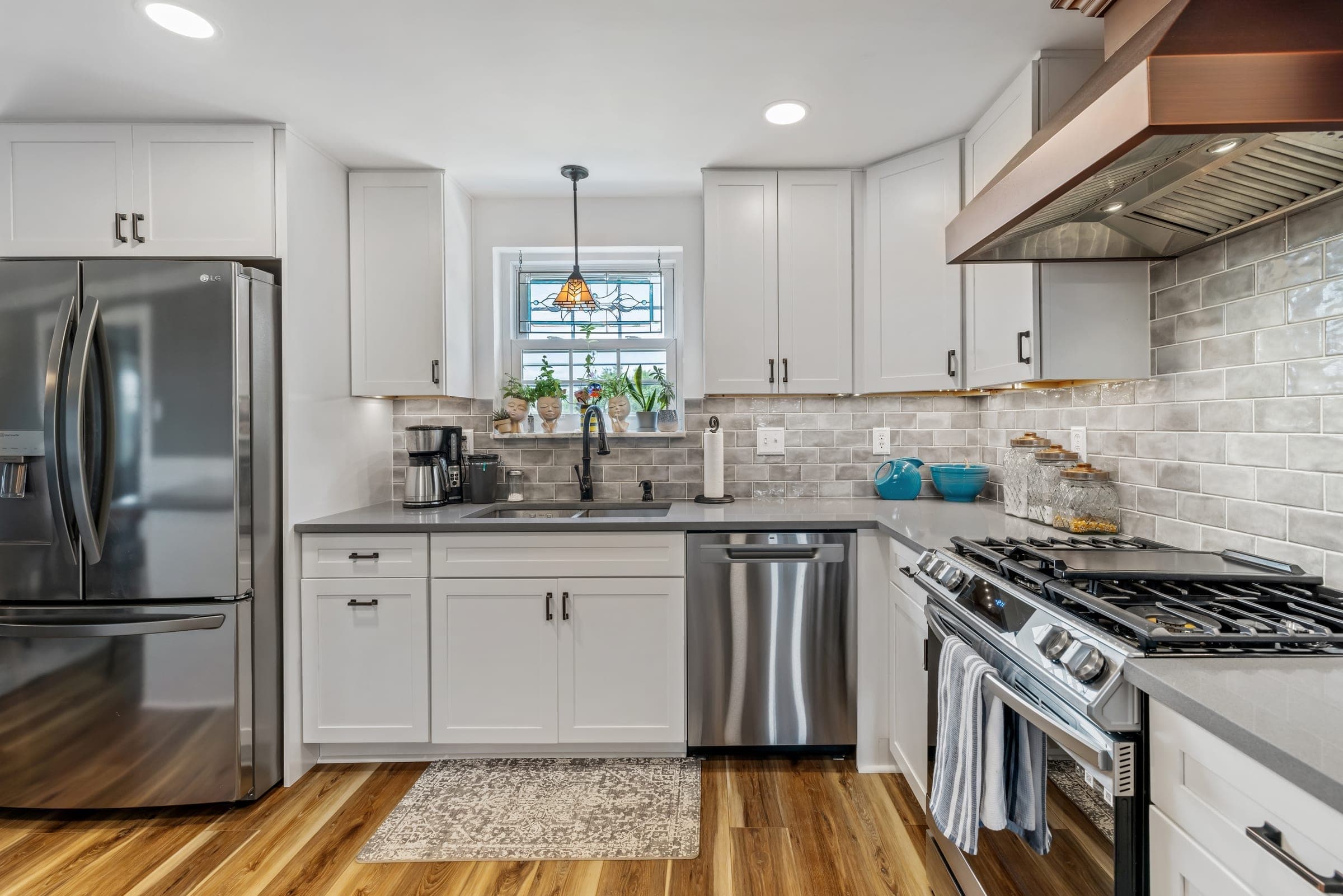
Our Nix Drive kitchen in Whitehall is a clean example. The homeowners wanted the wall between the kitchen and dining opened up. That wall was carrying load, so it got an engineered LVL header, a structural permit, and the header tied back into the existing roof load path — the same job the Sherwood Drive kitchen needed when we took out its galley wall. A cabinet company doesn't do that work, and shouldn't pretend to. When you're reading a contractor's portfolio, look specifically for opened walls and islands where an old wall used to be. That's the tell that they actually build kitchens rather than reface them.
What a Pittsburgh kitchen job actually involves
The specifics that eat kitchen budgets around here are usually the ones nobody put on the mood board. A few we hit routinely:
- The panel can't carry the kitchen. Older kitchens were wired for a fraction of today's load. The Sherwood Drive kitchen was running on two circuits when we started; the Norma Drive kitchen needed the whole panel upgraded to 200 amps to handle a modern range and dishwasher. That's real money that never shows up in a cabinet quote.
- Gas and plumbing get moved, and moving them means permits. On Nix Drive we ran a new gas line from the utility room for the range, permit-pulled and pressure-tested, and added a dedicated 20-amp circuit for a dishwasher the kitchen had never had. Relocating a sink means re-running drain and supply, not just swapping a faucet.
- Plaster, not drywall. Older Pittsburgh homes are plaster over lath, which is slower and messier to open and patch than drywall. It's the same reality we wrote about from the wall-removal angle in opening up a Pittsburgh kitchen, and it's a big reason honest kitchen quotes here run higher than a national average would suggest.
- Every municipality permits differently. Mt. Lebanon, Upper St. Clair, and Peters Township each run their own permit process; the City routes through PLI downtown on its own timeline. A contractor who works your town knows what the inspector will want and prices for it. One who doesn't finds out mid-job.
None of this is exotic. It's the ordinary reality of remodeling a kitchen in a house built decades before the appliances it now has to hold. The point is that the person you hire has to expect it, price it openly, and sequence the inspections — not discover it on demo day and hand you a change order.
What it costs, honestly
We won't quote your kitchen sight-unseen, and you should be wary of anyone who does. What we can do is show you real ranges from real jobs. Our completed kitchens land roughly between the low $30,000s and the low $60,000s depending on size, structure, and finish: the Greenwood Avenue kitchen in Avalon ran about $36K–$40K, while the Royce Avenue kitchen in Mt. Lebanon — a larger 1970s colonial main level with inset cabinetry and a new island — landed at $58K–$64K. The full breakdown of what drives those numbers is in our kitchen remodel cost guide.
The number that should make the spend easier: the kitchen is the highest-recapture room in the house. In this market roughly 70% of a kitchen's cost comes back as home equity — more than a bath, more than most projects — and that equity then appreciates with the house. We laid out the recapture math in the renovation ROI post. It doesn't make a kitchen cheap, but it makes it one of the few renovations that mostly pays you back. To see where your own project would land before you call anyone, the estimate tool and investment calculator use the same figures behind these guides.
One honest warning on price. When one kitchen bid comes in far below the others, that gap is almost always the invisible work — the header, the panel, the permit, the contingency for what demo uncovers. That work costs the same no matter who does it. A bid that leaves it out isn't a cheaper kitchen; it's a riskier one that looks identical on paper until the wall comes down.
How to vet the ones you find
Kitchen-specific pitfalls aside, vetting a kitchen contractor uses the same fundamentals as vetting any contractor, and we wrote those out in full in how to actually vet the contractors you find. The short version worth repeating here:
- Check the license first. Pennsylvania home-improvement contractors must register with the state Attorney General and carry a number — ours is PA157267. It verifies in two minutes and shrinks your list fast.
- Read the payment schedule like a tell. A fair one ties money to work performed. Ours is four milestones: 15% deposit, 35% on the first day of construction, 35% at the mid-project milestone, 15% after the final walk-through. A demand for half up front is solving the contractor's cash-flow problem with your money.
- Make them show you a kitchen like yours. Not "we've done hundreds" — an actual opened-wall kitchen with a scope and a real cost range you can look at. Ours are on the site with photos and honest numbers; browse the work and ask to talk to a homeowner.
- Ask who's on site and who pulls the permit. If a contractor suggests you pull the permit as the homeowner, they're making their work your legal problem. The right answer is "we pull it, and yes, we've worked in your municipality."
How we work — and when we're not your firm
We're a design-build firm handling kitchens, baths, basements, additions, and whole-home work across Mt. Lebanon, Upper St. Clair, Peters Township, and the greater South Hills. On a kitchen that means one crew from demo to final walk-through, licensed electricians and master plumbers we work with regularly, and the structural, gas, and electrical work priced as visible lines in the proposal rather than buried or skipped. Being straight about it: if you want a like-for-like cabinet swap at the rock-bottom number, a cabinet company will beat us on price and that's a reasonable choice. If you want a wall opened, the invisible work done right, and a payment schedule that protects you, that's the job we're built for. The way to find out if we fit is to get a real range and have a conversation.
Common questions
What should I look for in a kitchen contractor in Pittsburgh?
Start with the license — a valid Pennsylvania contractor registration number (ours is PA157267) you can verify online. Then look for evidence they do structural kitchen work, not just cabinet swaps: opened walls and islands where a wall used to be, in a portfolio of real projects with scopes and cost ranges. Confirm they pull the permits, have worked in your specific municipality, and can explain a payment schedule that ties money to work performed. In older Pittsburgh homes most real kitchen projects involve a load-bearing wall, a panel upgrade, or a gas-line move, so you want a contractor who expects that work and prices it openly.
Do I need a general contractor for a kitchen remodel, or just a kitchen company?
It depends on the project. If you're keeping the exact layout and only replacing cabinets and counters, a cabinet-and-counter company can handle it. The moment you want to open a wall, move the sink or range, or add circuits — which is what most people actually want — you need a contractor who coordinates the structural, plumbing, gas, and electrical trades and pulls the permits. In much of Pittsburgh's older housing stock, opening up a kitchen means removing a load-bearing wall, which is a structural job a cabinet company isn't set up to do.
How much does a kitchen remodel cost in the Pittsburgh area?
ICR's completed kitchens generally run from the low $30,000s to the low $60,000s, depending on size, whether structural work is involved, and finish level — for example, roughly $36K–$40K for the Greenwood Avenue kitchen in Avalon and $58K–$64K for the larger Royce Avenue main level in Mt. Lebanon. We don't quote a kitchen without seeing it. The kitchen remodel cost guide breaks down what drives the number, and the investment calculator gives a personalized range in about thirty seconds.
Why is one kitchen bid so much cheaper than the others?
Usually because it leaves out the invisible-but-necessary work: the engineered header for a load-bearing wall, a panel upgrade, permit fees, gas-line or plumbing relocation, and a contingency for what demolition uncovers. That work costs roughly the same regardless of who does it, so a dramatically low bid generally isn't a cheaper version of your kitchen — it's a different, riskier scope that looks the same on paper. Treat a far-lower bid as a prompt to ask what's missing.
Does opening up my kitchen require a permit?
If the wall is load-bearing — as it often is in older Pittsburgh homes — yes: removing it requires an engineered header and a structural permit, plus inspections. Moving gas, plumbing, or electrical typically requires permits too. Each municipality runs its own process, so the right contractor pulls the permits themselves and knows what your town's inspector will require. A contractor who asks you to pull the permit, or skips it, is a contractor to avoid.
Our kitchens renovation page →
The kitchen is the heart of the home — designed, built, and finished around how you actually cook.

Jordan Kelly is a co-owner and co-founder of Integrated Contracting & Renovations. A Pittsburgh native with an accounting degree from Saint Francis University, he has spent more than 15 years in Pittsburgh real estate and focuses on the numbers behind a renovation — what projects cost, what they return, and how homeowners finance them.
See how we built it.
Related reading.
Finishing a Basement in an Old Pittsburgh House
Both basements we have published are in newer houses, and that is exactly the comparison worth making. What a stone foundation, a low duct run, and eighty years of retrofitted mechanicals do to a basement project, the two free checks that tell you whether yours is a candidate at all, and why a partial finish is often the smarter plan rather than a compromise.
"General Contractors Near Me": How to Actually Vet the Ones You Find
Searching "general contractors near me" gives you a map full of pins and no way to tell them apart. Here's what "near me" should really mean in the Pittsburgh area, the questions that separate a real contractor from a good salesperson, and the red flags worth walking away from.
Basement Waterproofing in Pittsburgh: Signs, Fixes, and What It Costs
How to read the signs of a basement water problem, why Pittsburgh basements are especially prone to it, the fixes that actually work, and the honest answer on cost — plus why waterproofing always comes before finishing.