Spring is the best time to assess your basement — here's everything South Hills homeowners need to know before finishing theirs.
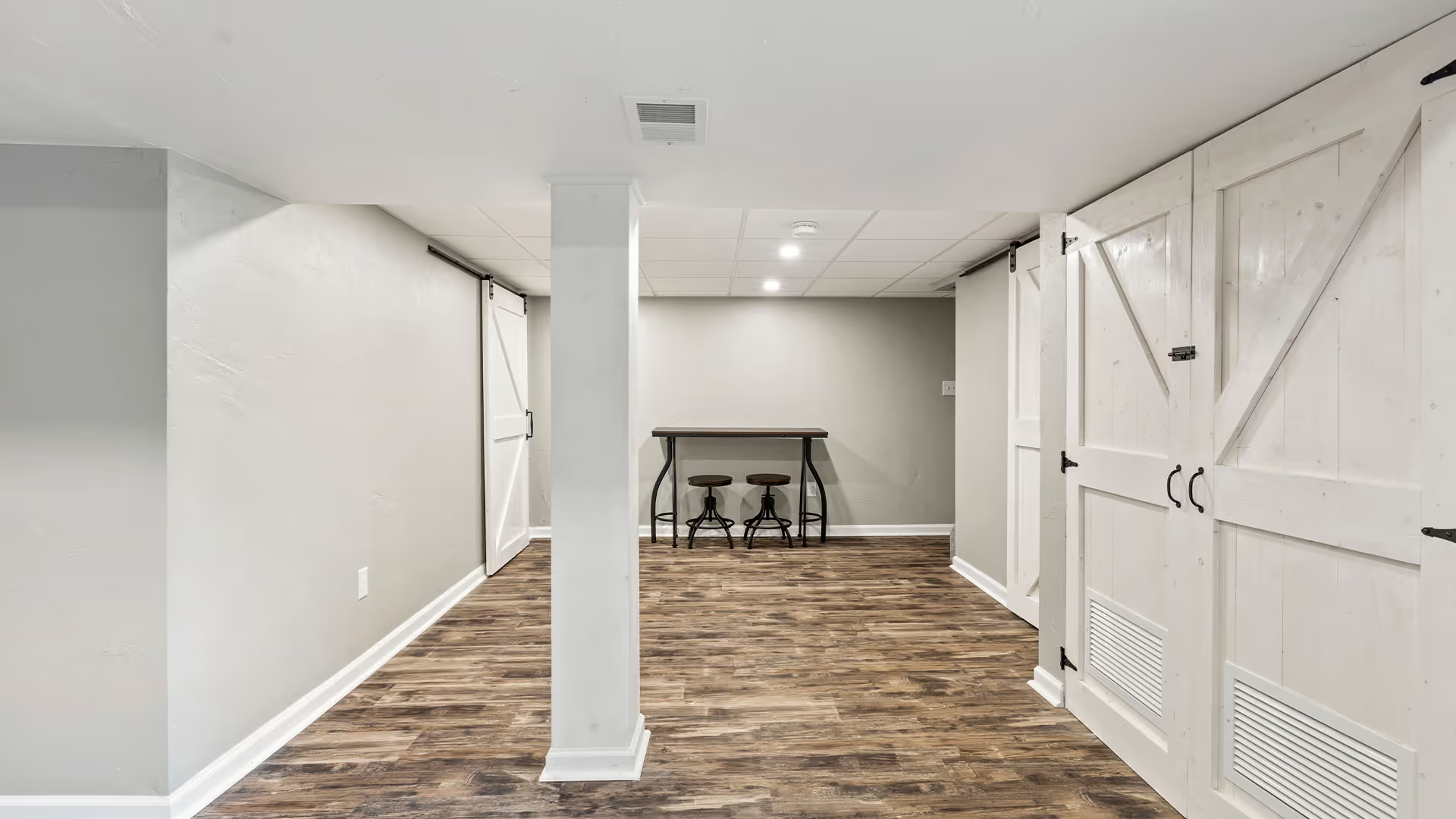
Most Pittsburgh homes have a basement. Most of those basements are unfinished. And most homeowners have had the same thought at least once: I should really do something with that space.
Spring is when that thought usually gets serious. You've spent the winter down there moving boxes, you noticed the corner that gets damp when it rains, and now the days are longer and you're thinking about what the house could look like with a real extra room — or two.
This guide covers what you need to know before starting: what finishing a basement actually involves, what it costs in the Pittsburgh area, what to deal with first, and how the process works with a contractor.
Quick Take: Finishing a basement in Pittsburgh typically costs $25,000–$65,000 depending on size, layout, and finishes. A basic open-concept finish runs lower; a full build-out with a bathroom, bedroom, and wet bar runs higher. The work takes 6–12 weeks once permits are pulled and materials are ordered.
It's not just the season making you think about it. There are practical reasons why spring is actually the best time to start a basement finishing project in Pittsburgh.
You can see what your basement does in wet weather. Pittsburgh averages 38 inches of rain a year and most of it concentrates in spring. Before you frame a single wall, you want to know if water comes in anywhere — and spring gives you a live test. A dry basement in April after three weeks of rain is a basement you can confidently finish. One with a wet corner in March needs waterproofing first.
Contractor scheduling is still open. By May and June, outdoor projects — decks, patios, driveways — fill up contractor calendars fast. Basement work is typically scheduled ahead of those projects. Starting conversations in April usually means you're on the schedule before summer, not waiting until fall.
You'll have the space ready before fall and winter. A basement finished by August becomes a home theater, a kids' playroom, a home office, or a guest suite — all before the football season starts and you actually want to use it.
The most expensive mistake in basement finishing is skipping the moisture evaluation. Framing walls over a damp foundation traps moisture inside the walls. Within a year or two, you're dealing with mold, rot, and a tearout that costs more than the original finish.
Before any finish work begins, answer these questions:
If you answered yes to any of these, address moisture before finishing. This could mean exterior grading corrections, interior drain tile installation, crack injection, or sump pump upgrades. A good contractor will walk through this with you before pricing the finish work.
If your basement is consistently dry — walls are clean, floor is dry, no musty smell — you can move directly to planning the finish.
When contractors talk about "finishing" a basement, they mean converting raw concrete and mechanical systems into livable, permitted square footage. Here's what that involves:
Pressure-treated lumber frames along the foundation walls create the structure for insulation and drywall. Interior partition walls define rooms. Framing also boxes out mechanical systems (ductwork, pipes, beams) that run through the space.
Basements lose heat through foundation walls. Proper insulation keeps the space comfortable and reduces energy costs. Most Pittsburgh basement builds use rigid foam board against the foundation wall before framing, with batt insulation in the stud cavities. This also creates a thermal break that helps control moisture.
A finished basement needs a dedicated circuit (or more, depending on use), outlets on every wall, lighting throughout, and anything specific to the room function — dedicated circuits for a home theater, GFCI outlets for a wet bar or bathroom. All electrical work requires permits and inspection in Allegheny County municipalities.
Existing ductwork usually doesn't reach basements or doesn't have enough capacity to heat and cool finished space. Most projects add supply and return vents, extend existing ductwork, or in some cases add a ductless mini-split for the basement zone.
Moisture-resistant drywall goes on the framed walls and ceiling (where ceiling height allows). This is the step where the space starts to look like a real room. Taping, mudding, and finishing take a week or more before paint.
Basement floors need to handle potential moisture and temperature swings. Luxury vinyl plank (LVP) is the most common choice — it's waterproof, comfortable underfoot, and looks good. Engineered hardwood and tile also work. Standard hardwood is not recommended for below-grade applications in Pittsburgh.
A basement bathroom requires rough plumbing below the slab — a significant cost driver. If a bathroom is in the plan, the plumbing rough-in happens early in the project before any flooring goes down. Expect a basement bathroom addition to add $8,000–$18,000 to the overall project cost.
Cost depends on three things: square footage, layout complexity, and finish level. Here's how it breaks down in the South Hills and surrounding areas.
Basic Open-Concept Finish
One large open room — family room, playroom, or home office. Minimal partition walls, no bathroom, standard finishes.
Cost range: $25,000–$38,000 for a typical 600–800 sq ft basement
Mid-Range Build-Out
Two or three rooms, one bathroom, recessed lighting, LVP flooring, painted drywall, basic trim. This covers the most common basement finish in Upper St. Clair, Mt. Lebanon, and Bethel Park.
Cost range: $40,000–$55,000 for 800–1,000 sq ft
Full Finish with Custom Features
Home theater, wet bar, full bathroom, custom built-ins, higher-end flooring, accent lighting. These projects are essentially a full apartment built underground.
Cost range: $60,000–$90,000+
A useful benchmark for budgeting:
Finishing a basement in Allegheny County requires permits. This isn't optional. Here's what you're looking at:
Building permit — Required for all structural and finish work. Your contractor applies for this. Expect $300–$600 depending on municipality and project scope.
Electrical permit — Required any time new circuits, outlets, or panel work is involved. Your electrician pulls this.
Plumbing permit — Required if a bathroom or wet bar is included. Your plumber pulls this.
Egress window — required for bedrooms. If you're adding a bedroom in the basement, Pennsylvania code requires an egress window: minimum 5.7 square feet of opening, at least 24 inches tall and 20 inches wide. This means cutting into the foundation wall, which adds cost but is required for the space to legally be called a bedroom. Egress window installation typically costs $2,500–$5,000 per window including the well and cover.
Unpermitted basement finishes create problems when you sell your home — inspectors find them, and buyers ask for them to be torn out or the price to be reduced. It's not worth skipping.
How long does it take to finish a basement?
Most basement finishing projects in Pittsburgh take 8–14 weeks from permit approval to final walkthrough. Simple open-concept finishes run closer to 6–8 weeks. Projects with a bathroom, custom features, or moisture remediation take longer. Lead time for permits is typically 2–4 weeks before work can begin.
Does a finished basement add value to my home?
Yes, meaningfully. Finished basements typically return 65–75% of cost at resale in the Pittsburgh market, and they help homes sell faster. In neighborhoods like Upper St. Clair and Mt. Lebanon, where homes are often compared side by side, finished basement square footage is a significant differentiator. A mid-range basement finish adds usable square footage at roughly half the cost of a home addition.
Can I finish a basement with 7-foot ceilings?
Yes — 7 feet is workable and actually meets code minimum in most municipalities. Ductwork, beams, and pipes may require soffits or creative solutions, but the space can absolutely be comfortable. The challenge is usually low spots or beams that drop below 7 feet. A contractor can walk through your space and tell you what's achievable before you commit to a layout.
What's the best flooring for a Pittsburgh basement?
Luxury vinyl plank (LVP) is the most popular choice for good reason — it's fully waterproof, easy to replace individual planks if something happens, comfortable to walk on, and looks like wood without the risk of warping. Tile is also excellent for moisture resistance. Engineered hardwood works if moisture levels are well-controlled. Standard solid hardwood is not recommended below grade.
Do I need to waterproof before finishing?
Only if there's evidence of moisture. A basement that's been consistently dry through multiple Pittsburgh winters and springs can typically be finished without additional waterproofing. If there's any evidence of water intrusion — staining, efflorescence, musty smell — address it first. Finishing over a moisture problem seals it in and makes it worse.
What's the difference between waterproofing and finishing?
Waterproofing prevents water from entering the basement — it involves drainage systems, sump pumps, crack injection, or exterior membrane work. Finishing is everything that converts the dry, waterproofed space into livable square footage. Waterproofing comes first, finishing comes second. Some companies do both; others specialize in one or the other. ICR does basement finishing — if waterproofing is needed, we'll tell you before we start.
Can I add a bathroom to an unplumbed basement?
Yes, but it requires breaking into the concrete floor to rough in drain lines. This is common and manageable, but it adds $3,000–$6,000 to the plumbing cost versus a basement that already has rough plumbing stubbed in. The concrete gets patched over after the rough-in — you won't see it once flooring goes down.
What should I use my finished basement for?
The most common uses in Pittsburgh: home office (especially post-2020), kids' playroom, family room or home theater, guest bedroom suite, home gym, or a combination of two. A bedroom suite adds the most resale value but requires egress compliance. A home office or family room is simpler and still significantly increases usable square footage.
Need help financing the project? See our full breakdown of home renovation financing options — including HELOCs, home equity loans, and renovation loans — before you talk to a lender.
Get a detailed estimate for your Pittsburgh-area basement project from Integrated Contracting & Renovations.
Get In Touch